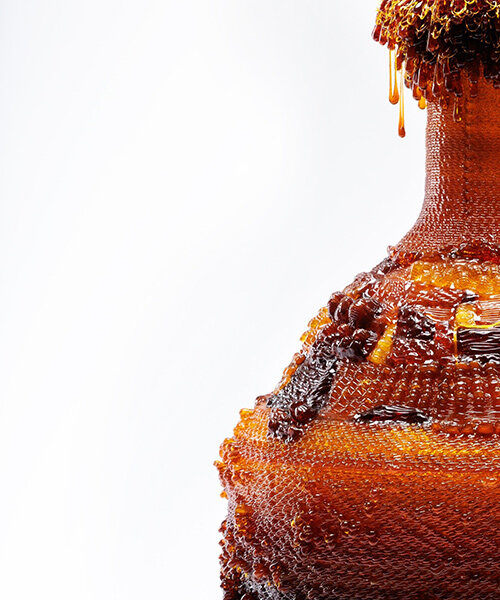
these glowing amber sculptures begin with a natural polymer produced by tiny insects
ori orisun merhav explores a future of multispecies design, where biological processes inform how we manufacture and inhabit the world.
prefer designboom on google[FEATURED]
insects make the material for ori orisun merhav’s sculptures
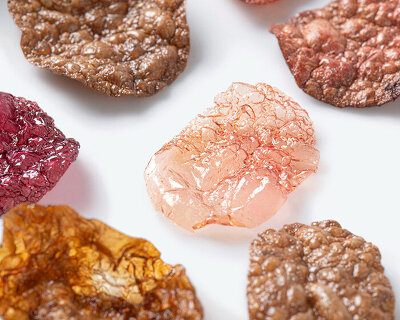
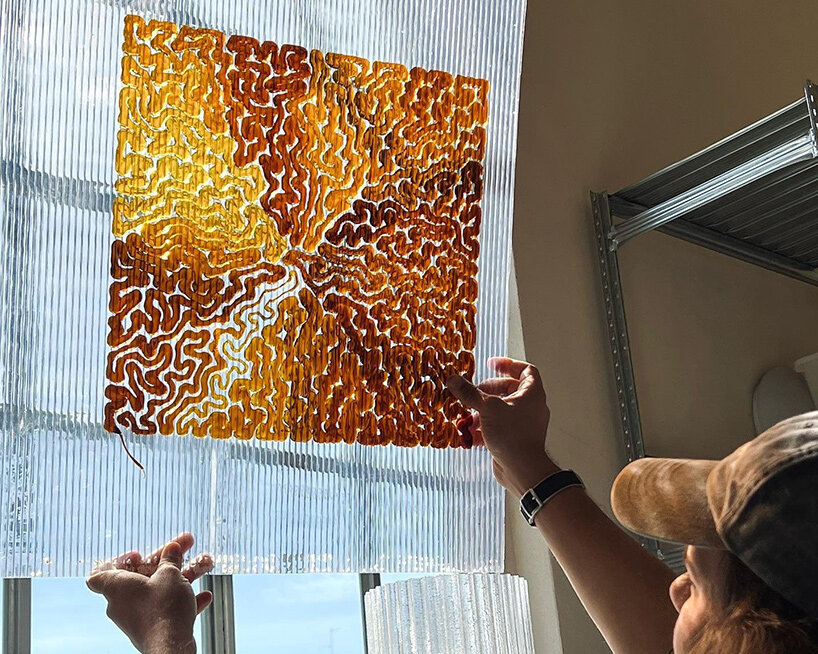
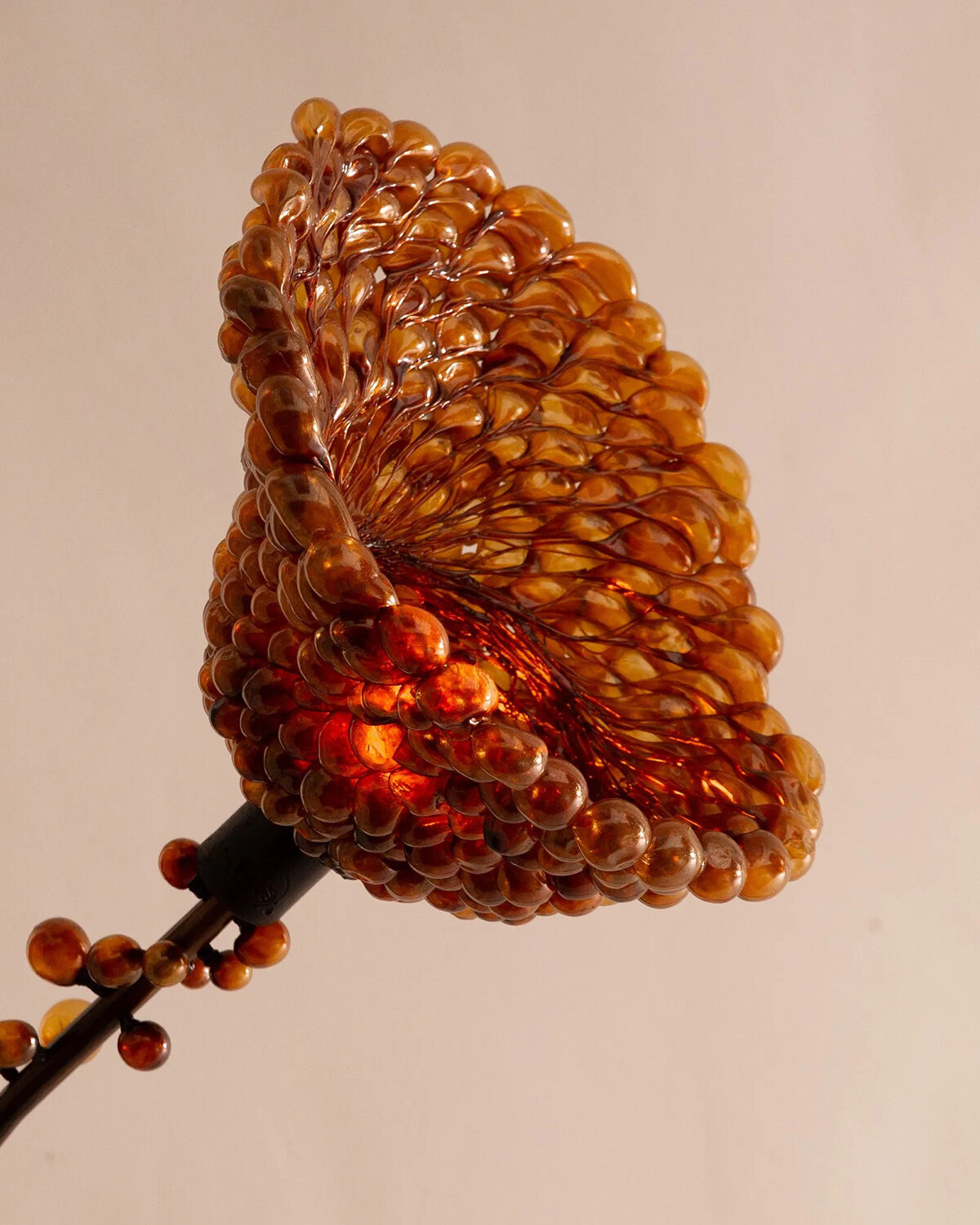
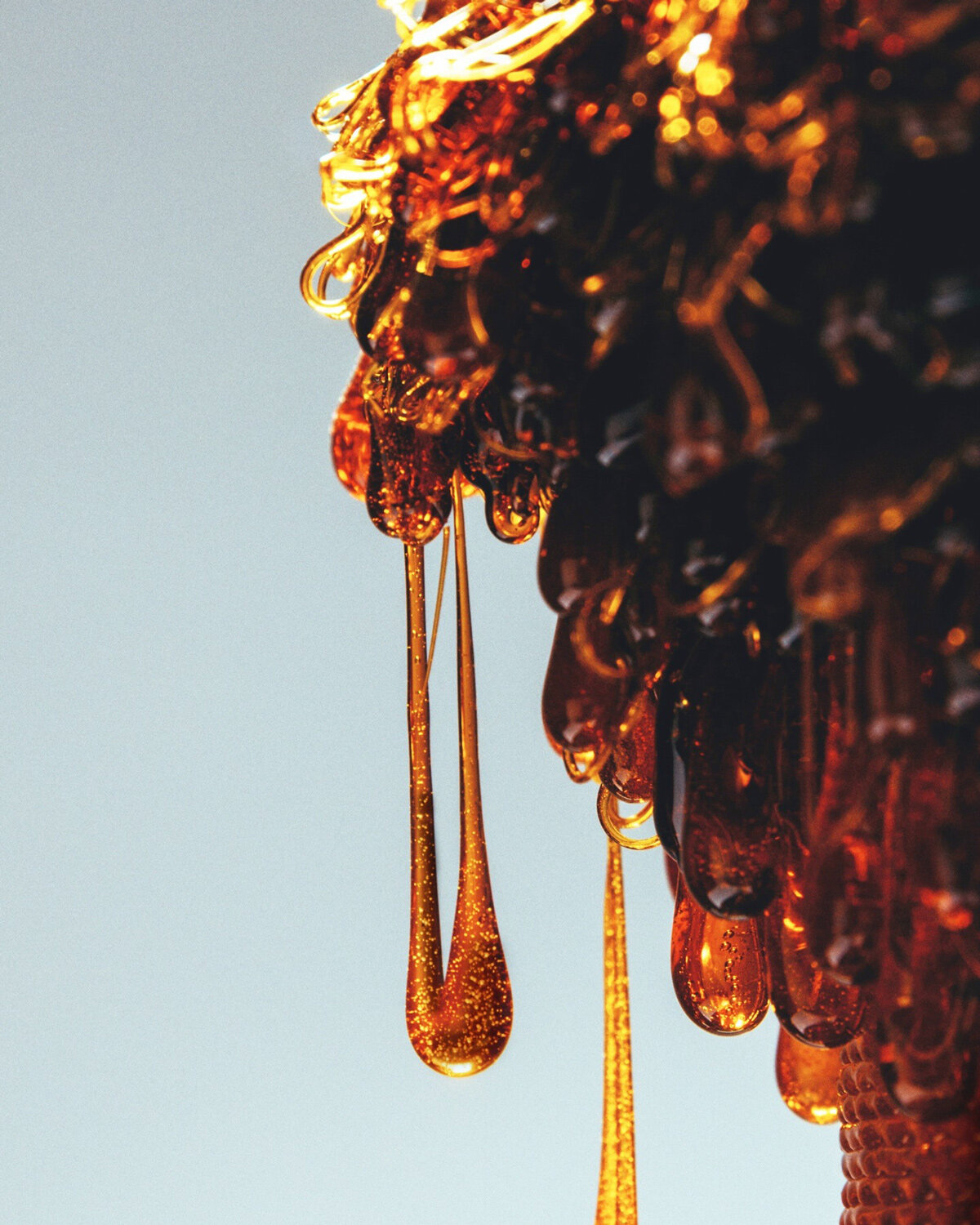
Brussels-based designer Ori Orisun Merhav is experimenting with a natural polymer produced by tiny lac insects, transforming their resinous secretions into glowing sculptures and sculptural furniture. Through her research practice Made by Insects, she heats and blows the amber-colored material into clusters of translucent bubbles, some perched on branching steel structures, others suspended as elaborate chandeliers.
The material is known commercially as shellac, a substance typically used as a protective coating. Here in Merhav’s hands, it takes on a completely different spirit.
Her latest works extend the research into 3D printing and large-scale installations, imagining how an insect-produced material might become part of our built environment. After years of research into the insects themselves, the designer has received a 2026 Dutch Design Award for her experimental approach to material production.
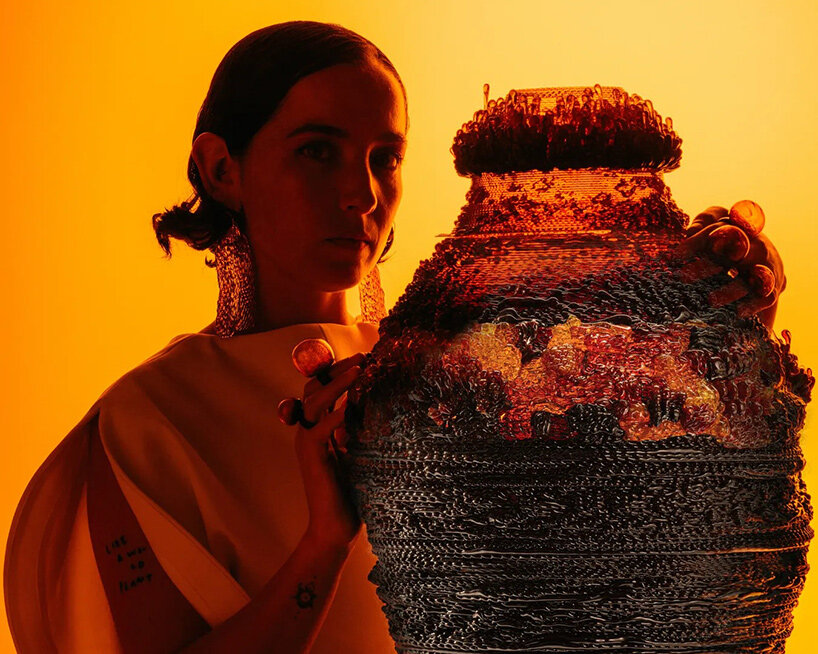
the tiny insects behind an unlikely design material
The insects that produce this shellac are known scientifically as Kerria lacca, and are roughly the size of a grain of sand. They attach themselves to the branches of host trees and feed on their sap, converting sugars into a natural resin that hardens around their bodies. This protective enclosure allows the insects to develop and reproduce. The hardened resin can then be collected from the branches, washed and processed into shellac, a material humans have used for centuries in furniture finishing and other applications.
Designer Ori Orisun Merhav first encountered the insects while researching ecological relationships during her studies at Design Academy Eindhoven. She was fascinated by their ability to manufacture a polymer through their own biological processes, and she traveled to Thailand to study lac cultivation and meet the communities who harvest it. There, she learned about the insects’ life cycles and the agricultural practices surrounding their production.
The research became her 2022 graduation project, The Lac Lab Open Source, an evolving archive of material experiments that eventually grew into Made by Insects. It also introduced her to the economic realities of shellac production, as synthetic alternatives have steadily reduced demand for the natural resin.
learning to build from the insects themselves
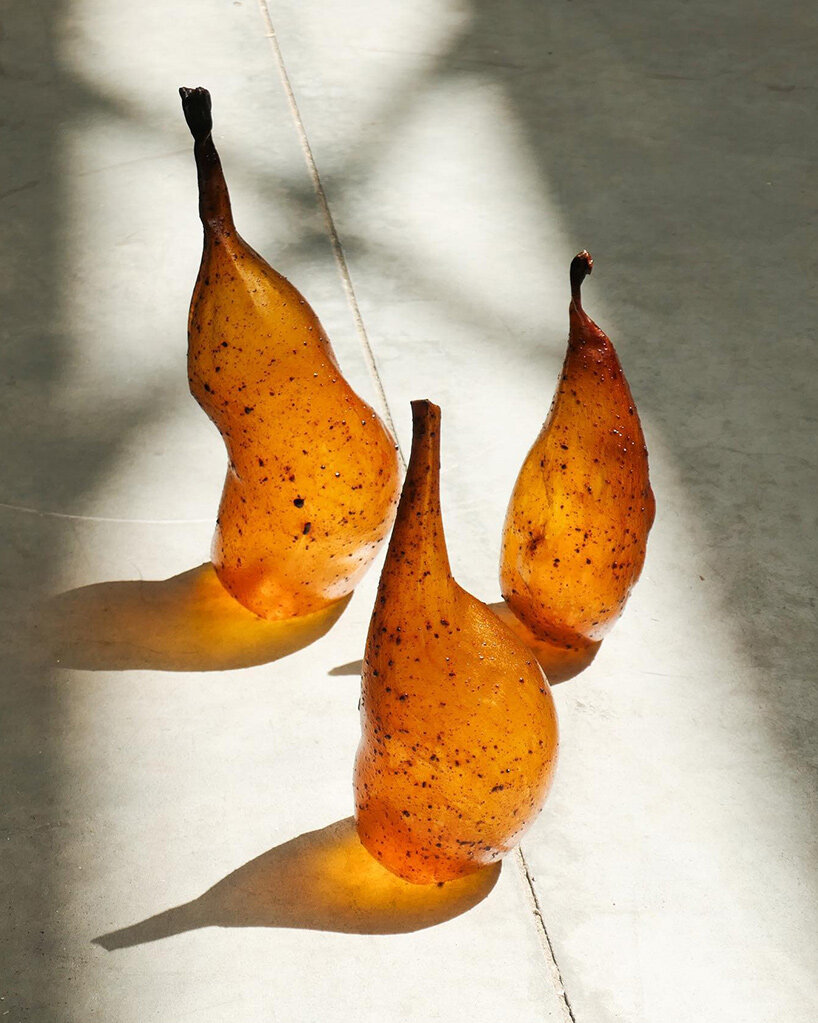
Back in her studio, Merhav began testing what the material could do beyond its traditional applications. Shellac softens when heated and hardens again as it cools, allowing her to stretch it into thin membranes and blow it into hollow forms using techniques borrowed from glassmaking.
Her earliest experiments produced large, individual bubbles, but their delicate walls made them brittle and difficult to transport. Looking more closely at the insects’ protective structures, she discovered that their enclosures comprised many smaller, interconnected cells.
The observation changed her approach. Merhav began blowing smaller volumes and joining them into larger structures, developing a new language of clustered forms that draws directly from the insects’ construction methods. In works such as Branching Insects Chandelier and Meet Me Under the Insects Tree, the amber bubbles grow along slender metal supports, casting warm light through their uneven surfaces.
The finished pieces have an almost botanical appearance, although their structural logic comes from the resinous shelters of insects.
3D printing a polymer made by another species
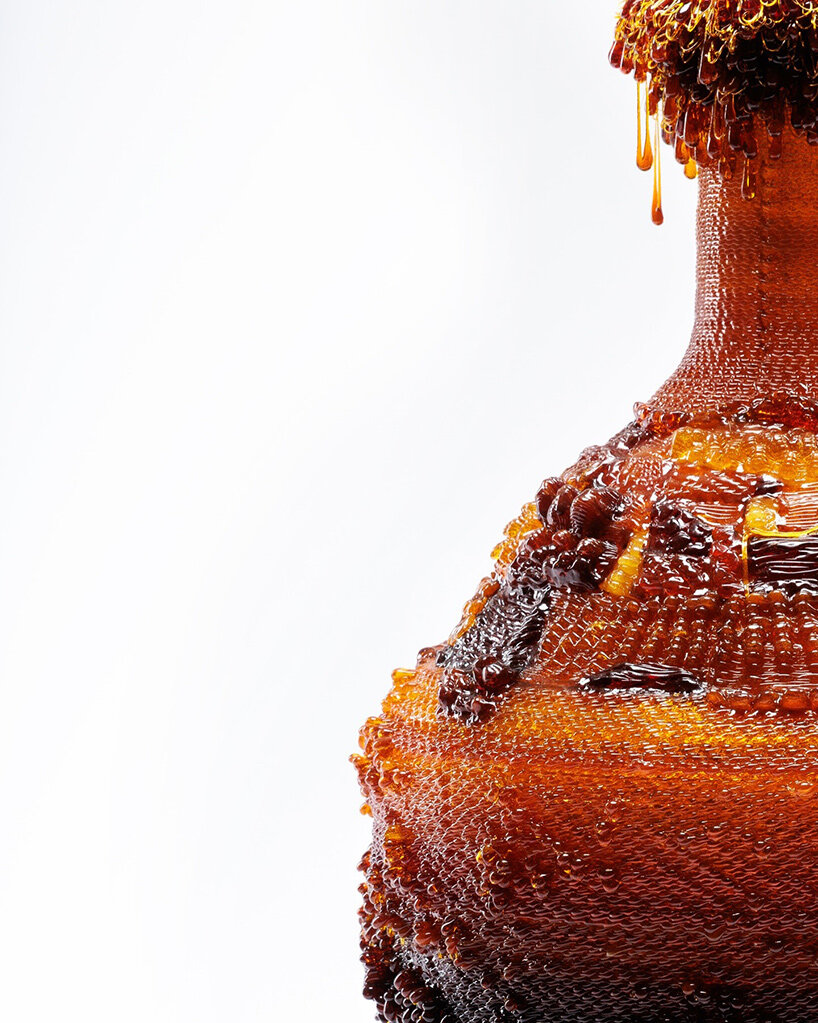
Merhav’s experiments have since expanded into digital fabrication. Working with Ginger Additive, Reflexlab and Aeditto, she produced her first 3D-printed shellac objects in 2023, later continuing the research with material engineer Tom Samson and the Bio-Polymer Lab at Avans University of Applied Sciences in the Netherlands.
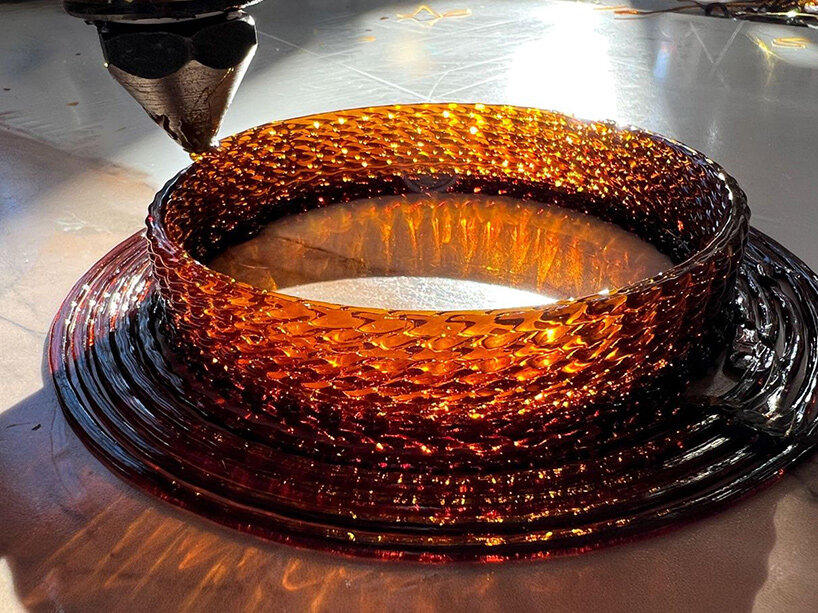
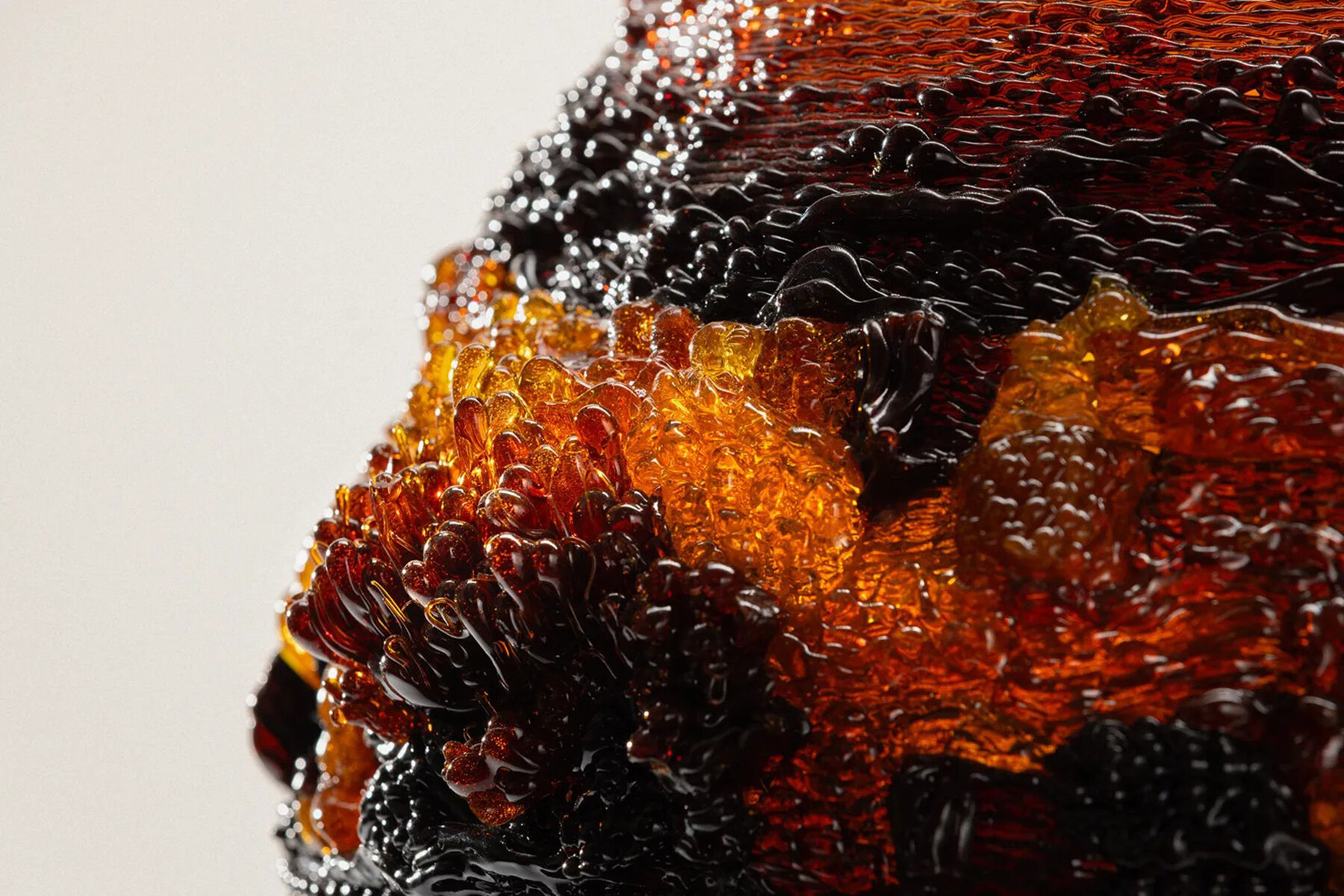
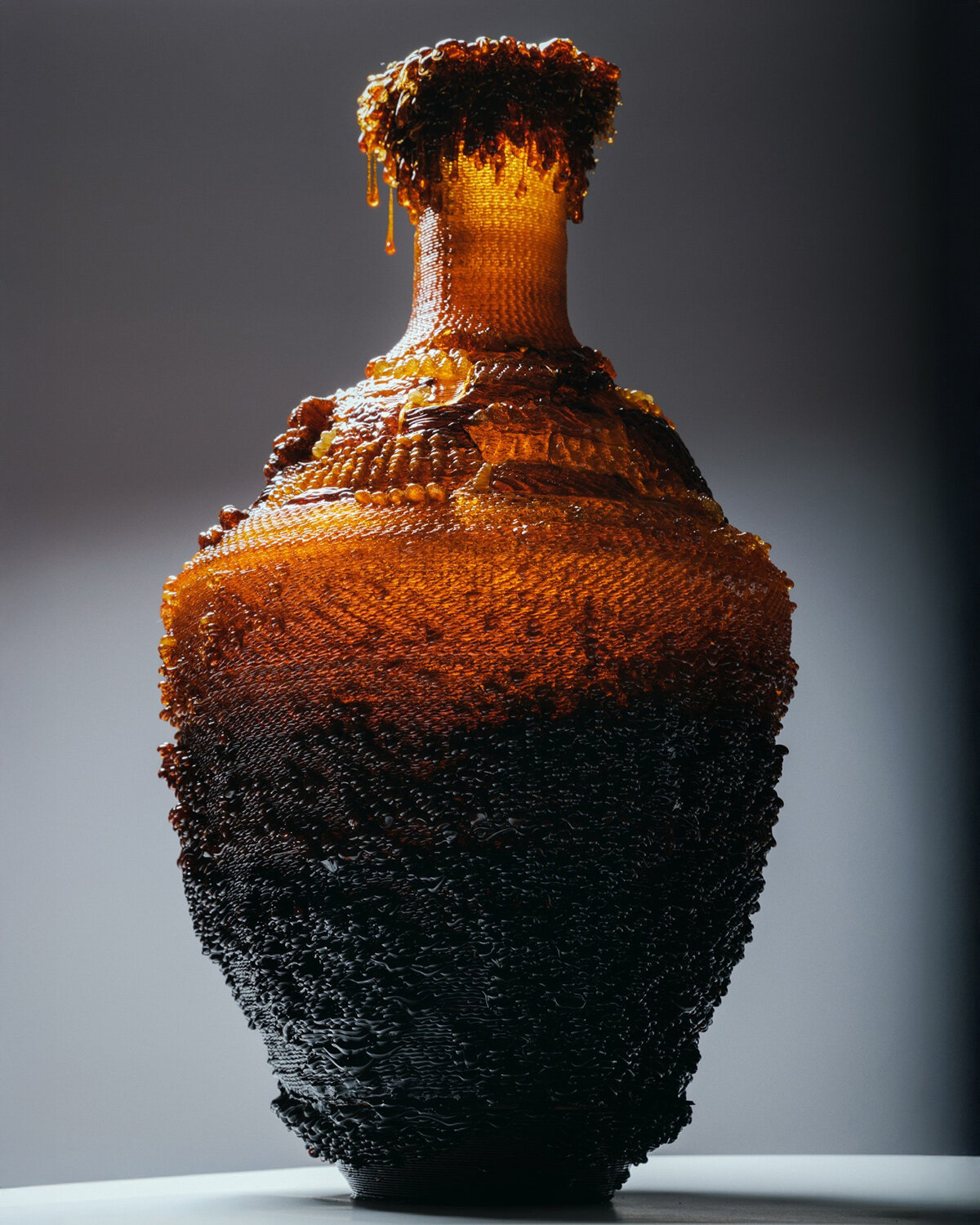
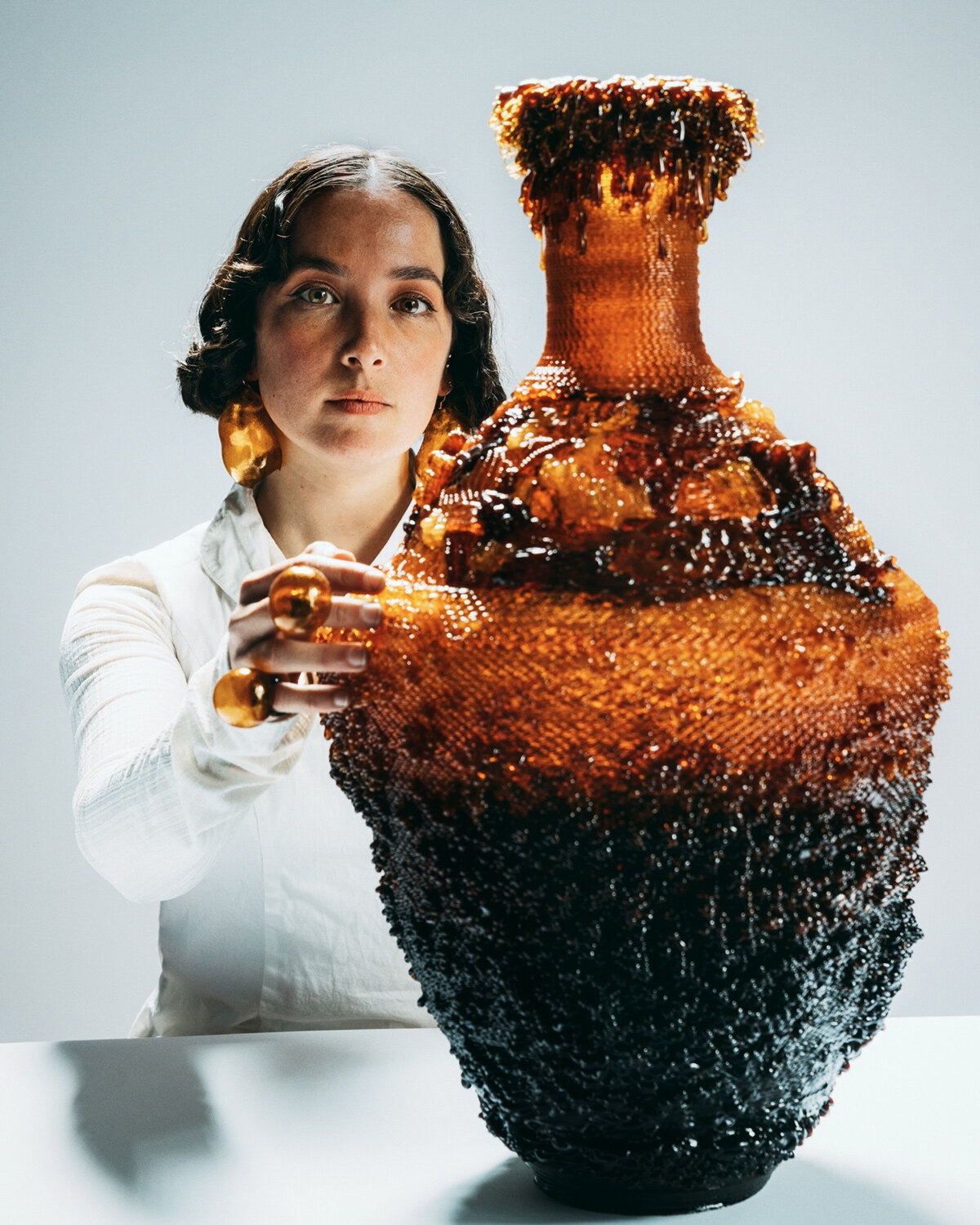
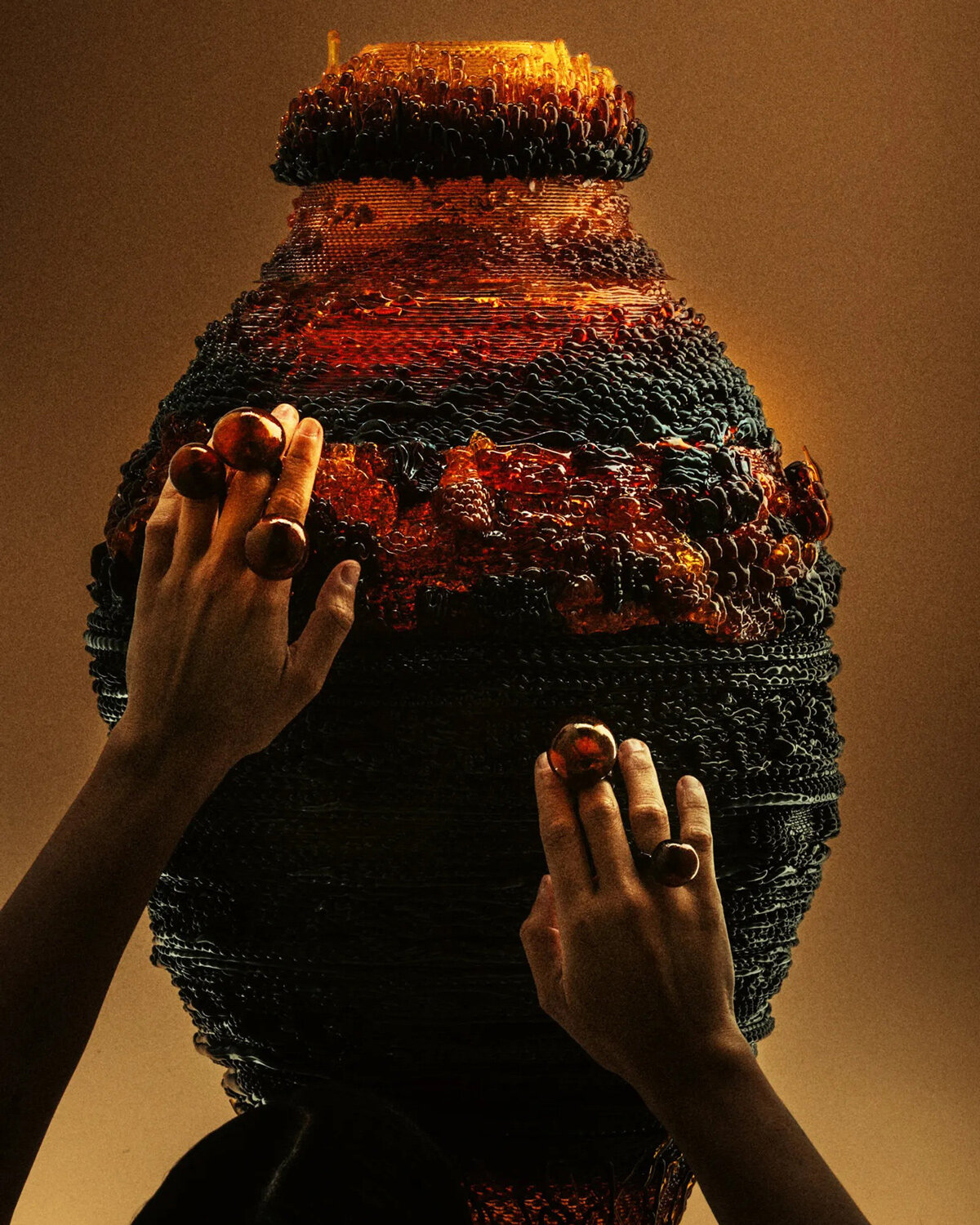
The process explores how a naturally occurring polymer can move through a printer without chemical modification. Temperature and the material’s behavior during extrusion influence the forms as they take shape, leaving behind uneven surfaces and visible layers of hardened resin.
Her Morphopoiesis vessels offer a closer look at this emerging technique. The objects rise in irregular, cellular walls, with ridges of deposited material forming dense networks around their hollow interiors.
a woven insect canopy takes shape in london
At Sarah Myerscough Gallery, Merhav’s ongoing research has grown into an environment visitors can move through. Portal Into The Multi-Species, on view from October 14th to November 7th, 2026, occupies the gallery’s entrance corridor with delicate shellac bubbles attached to steel branches. Further inside, the forms become larger and more textured.
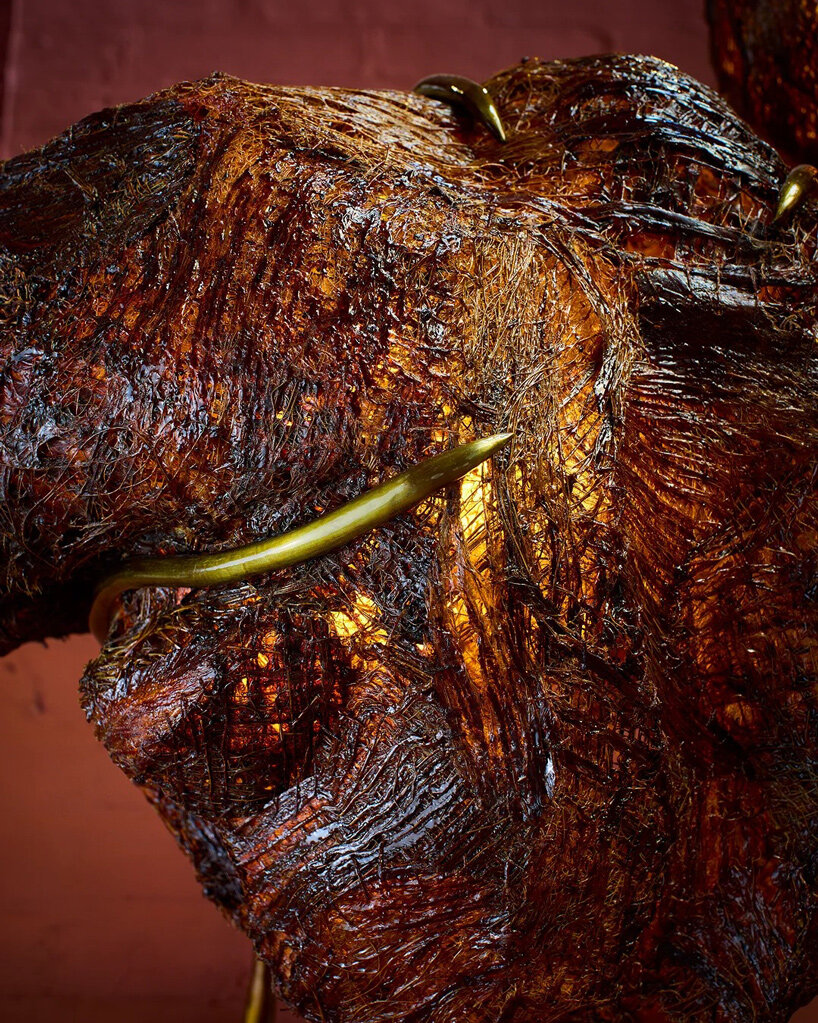
In The Woven Insect Canopy, palm sheaths coated in insect-produced resin are held within sculptural steel supports, their fibrous surfaces illuminated from within by LEDs.
The series includes Awakening, Regeneration and Bifurcation, the latter reaching 140 centimeters in height. Light passes through the shellac-coated fibers to reveal their interwoven structure beneath the amber surface. The works point to an interior shaped by biological processes. A material originally created as a protective shelter has become part of an imagined architecture.
who makes the materials we live with?
Merhav’s interest in mutualism runs through the project, beginning with the relationship between lac insects and the trees that sustain them. The insects depend on their hosts for nourishment, while cultivation involves managing the trees’ health and the insects’ reproductive cycles.
Human participation adds another layer, through the farmers who maintain these environments and the makers who work with the harvested resin. The ecological relationship itself is complex, yet the research draws attention to the many participants involved in producing a single material.
These sculptures, for Merhav, are part of a much longer exploration of how these relationships might inform design. The work remains experimental, with the material’s fragility and the demands of fabrication continuing to shape its possibilities. Still, her lamps and vessels offer a tangible glimpse of an unusual manufacturing future. An insect produces a polymer to protect itself on a tree branch. Generations later, a designer studies that structure and finds a way to build with it.
1/6
project info:
designer: Ori Orisun Merhav | @ori_orisun
research practice: Made by Insects

shop
your own online design shop — no sales commission collected