
inside the hand-painted animations bringing isamu noguchi’s unrealized playgrounds to life
designboom speaks with eastend western and curator kate wiener about imagining isamu noguchi’s unrealized playgrounds through five hand-painted animated films.
bringing noguchi’s unrealized playgrounds into motion
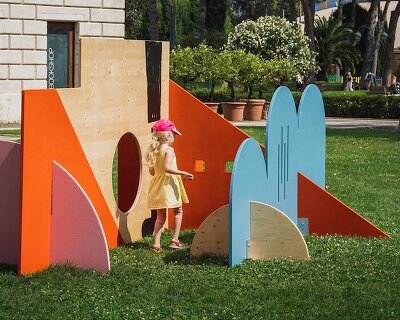
For decades, Isamu Noguchi’s unrealized sculptural playgrounds are preserved as plaster models, drawings, and blueprints, admired for their abstract beauty, remaining strangely detached from the purpose for which they were conceived: children at play. For the Noguchi’s New York exhibition at The Noguchi Museum, marking the institution’s 40th anniversary, five of those unbuilt proposals step beyond the archive through a series of hand-painted animated films by London-based studio Eastend Western, inviting viewers to imagine what it might actually have felt like to move through them.
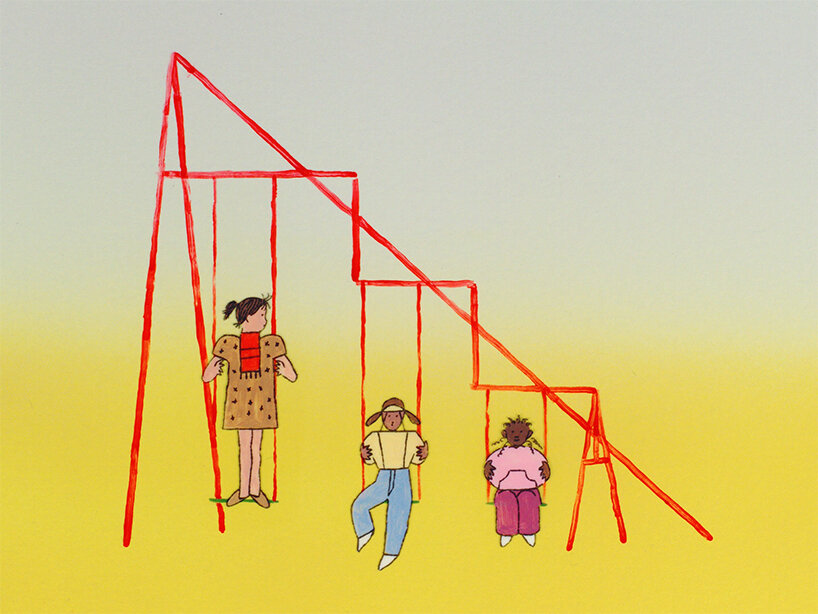
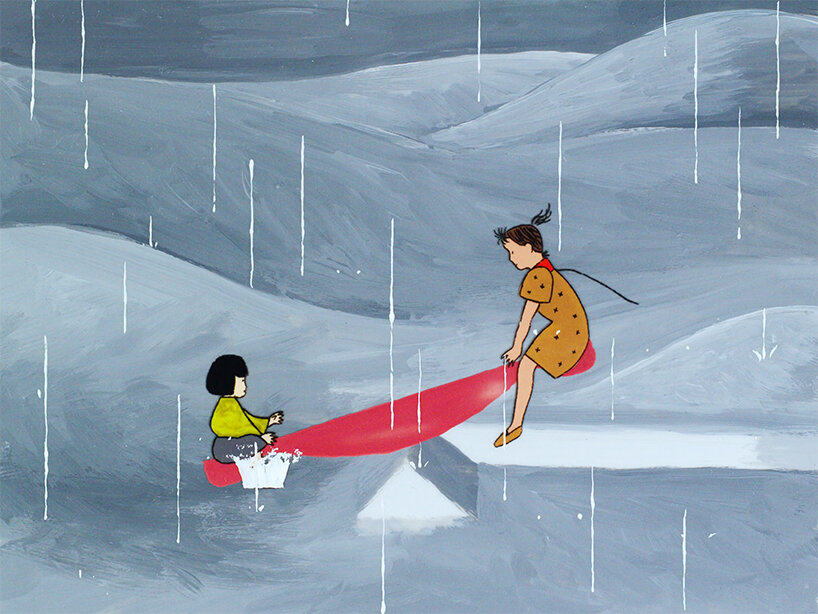
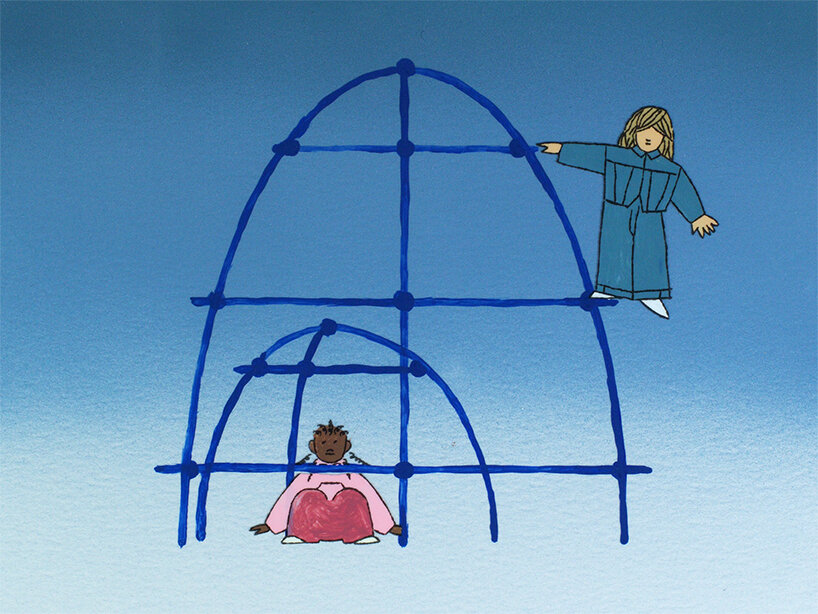
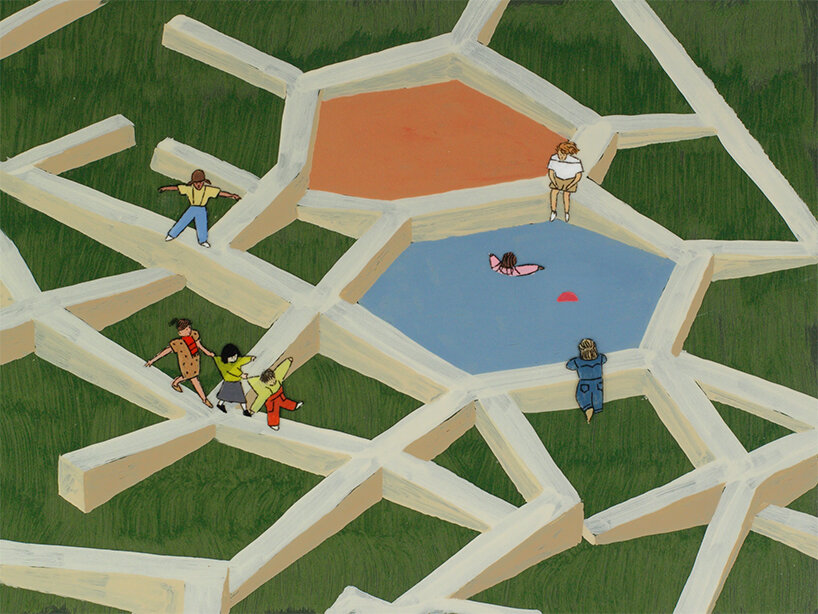
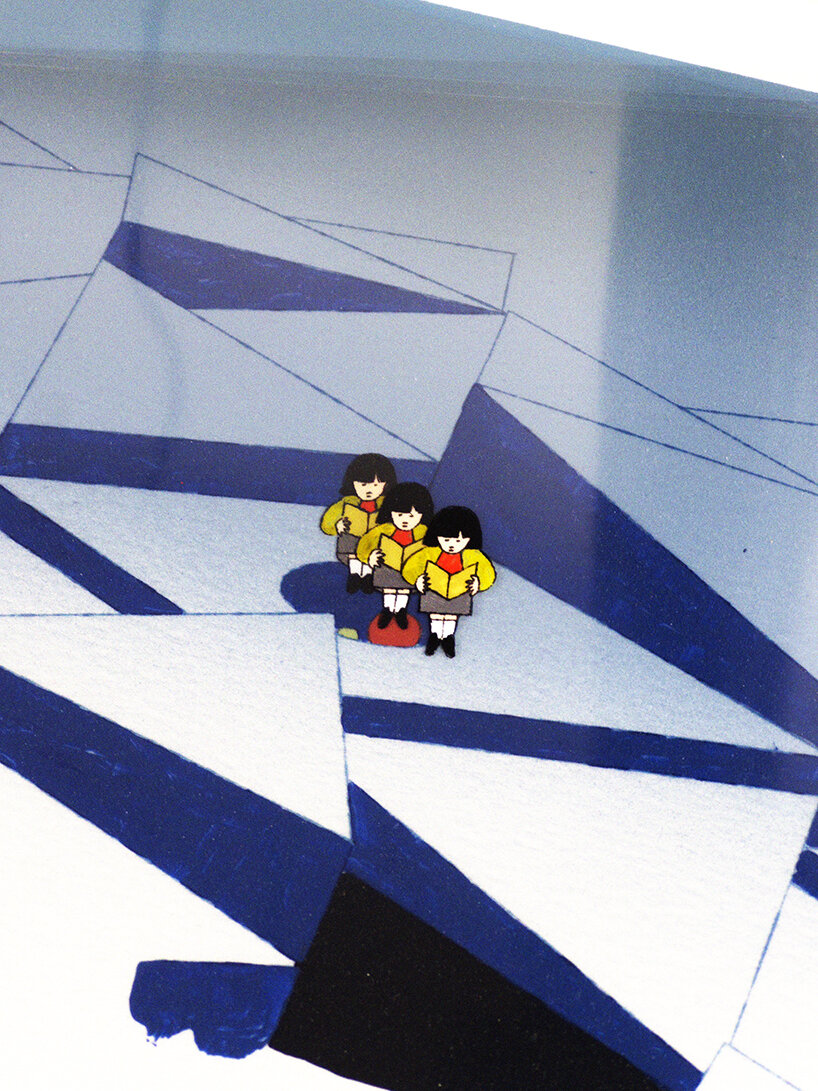
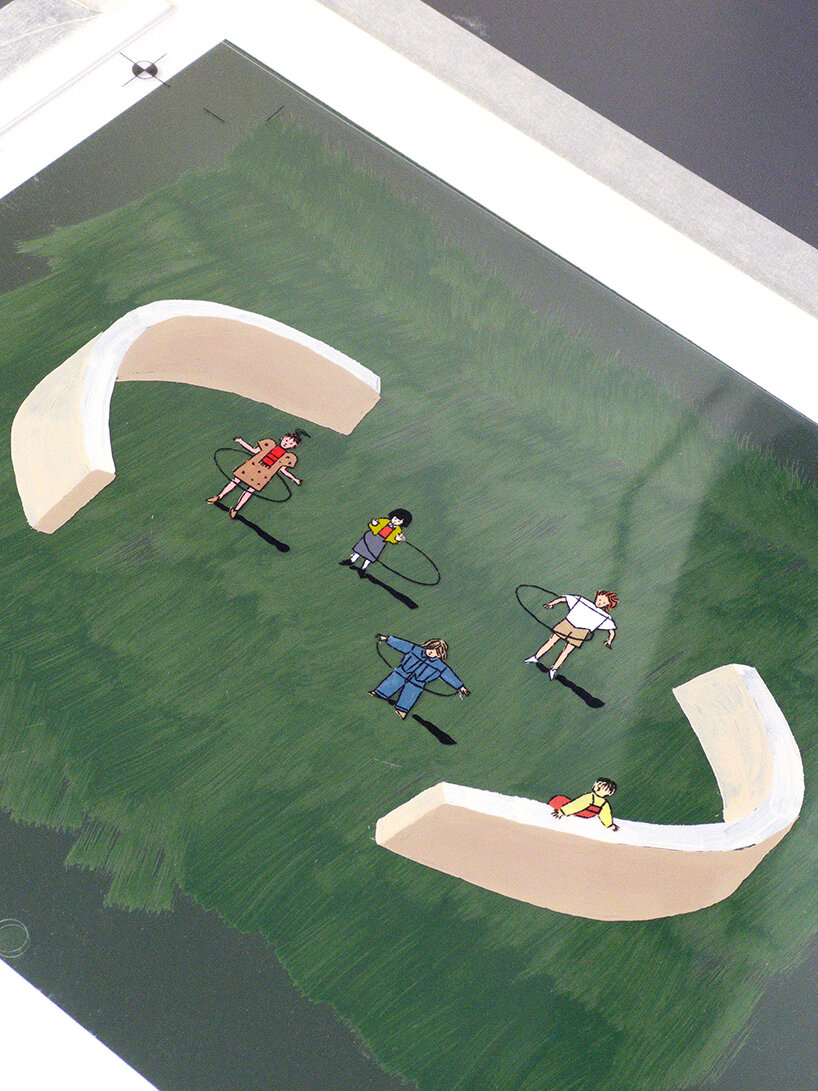
The five short animations reinterpret Play Mountain (1933), Playground Equipment (1940), Contoured Playground (1941), United Nations Playground (1952), and Riverside Playground (Adele Levy Memorial Playground, 1961–62). Across them, children swing from bright red climbing structures, drift across softly contoured earthworks, gather inside circular play spaces, and slide through snowy landscapes. Some films play out almost like miniature stories, while others observe Noguchi’s sculptural forms from shifting viewpoints. Together, they present not simply what these playgrounds looked like but how they might have been experienced.
To understand how the films came together, designboom spoke with Eastend Western directors Nicolas Ménard and Jack Cunningham, alongside Kate Wiener, curator of Noguchi’s New York, about translating Noguchi’s unrealized proposals into moving images, balancing interpretation with historical fidelity, and the role animation can play in giving unbuilt architecture a second life.
why the noguchi museum chose animation over renderings
‘The exhibition explores Noguchi’s relationship with New York City, and the many ways he set out to, as he said, “make New York a little bit better place,”’ curator Kate Wiener tells designboom. ‘Central to his vision was a desire to sculpt a non-traditional playground for the city — a playscape without explicit directions where kids could explore, imagine, and discover in endless ways.’ The exhibition brings together models for five unrealized playgrounds, yet Wiener realized they risked being understood as autonomous sculptures rather than proposals for public space.
‘While the models are interesting and beautiful in their own way, sometimes they can read more like abstract sculpture than proposals for spaces,’ she explains. ‘The animated films bring these imagined spaces to life and help people better imagine what it may have been like to explore and play in them.’ That challenge led directly to the choice of animation. ‘We had even considered something more along the lines of an architectural rendering,’ Wiener adds. ‘But there are so many things we don’t actually know about the playground proposals — their exact scale, location, materials, etc. We wanted to preserve a sense of openness and imagination rather than answer every question or prescribe a single interpretation. Animation felt like a perfect playful and timeless medium for this.’
Contemporary architectural visualization often seeks certainty, producing polished images that resolve every surface, shadow, and material. Eastend Western embraces ambiguity through their films, which never claim to reconstruct Noguchi’s proposals faithfully, but inhabit them.
Eastend Western on painting 1,800 celluloid frames by hand
For directors Nicolas Ménard and Jack Cunningham, the commission began with an education. ‘Kate prepared a thorough presentation going through the history and thinking behind each playground,’ they recall. ‘It was the most fascinating brief we’ve ever received by a mile, so inspiration came easily.’
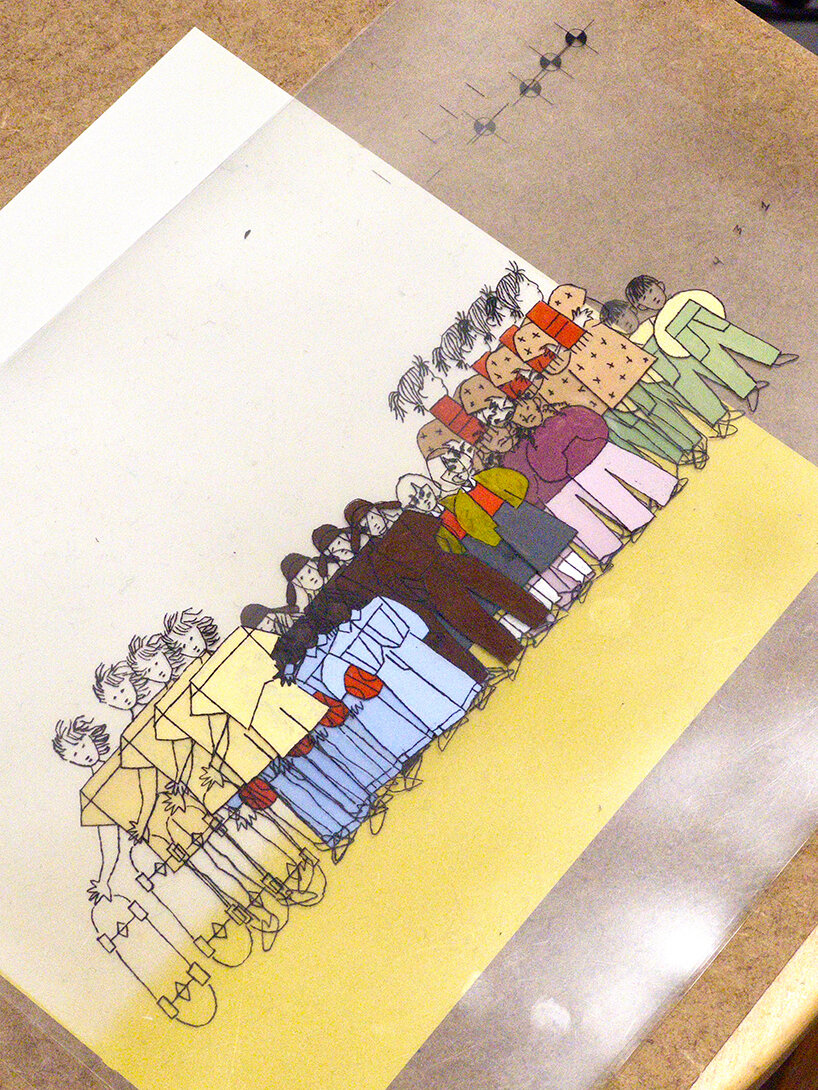
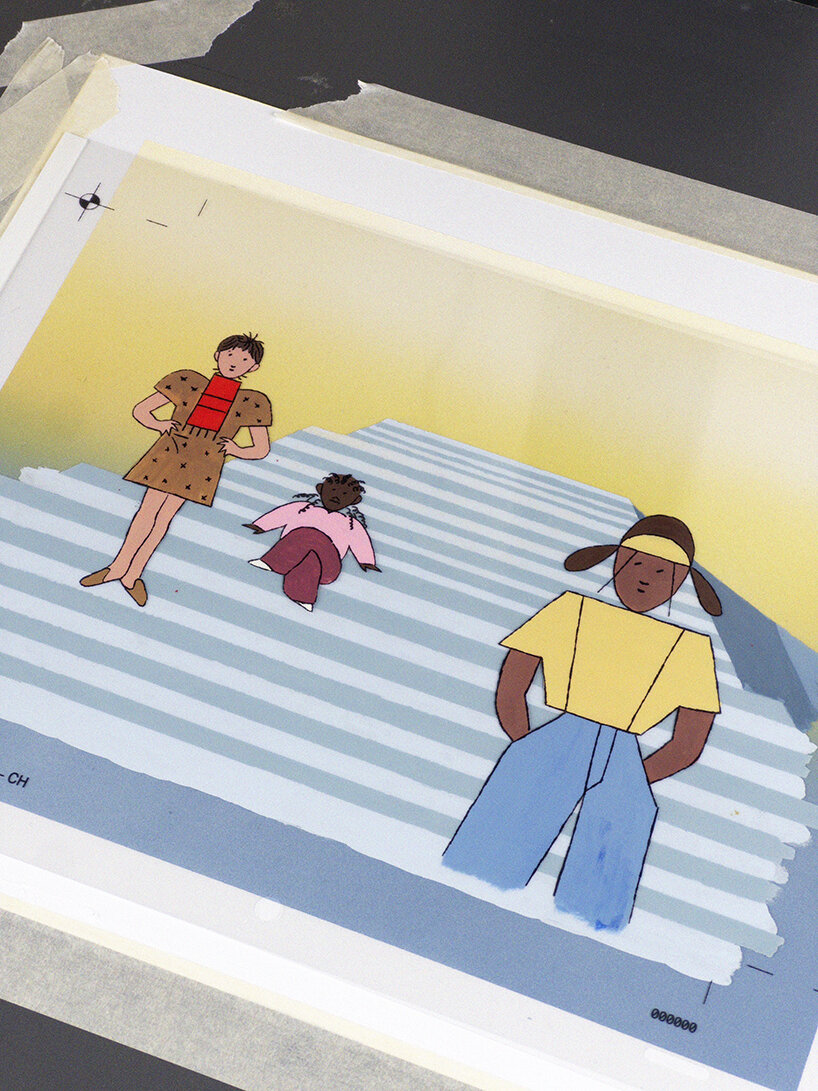
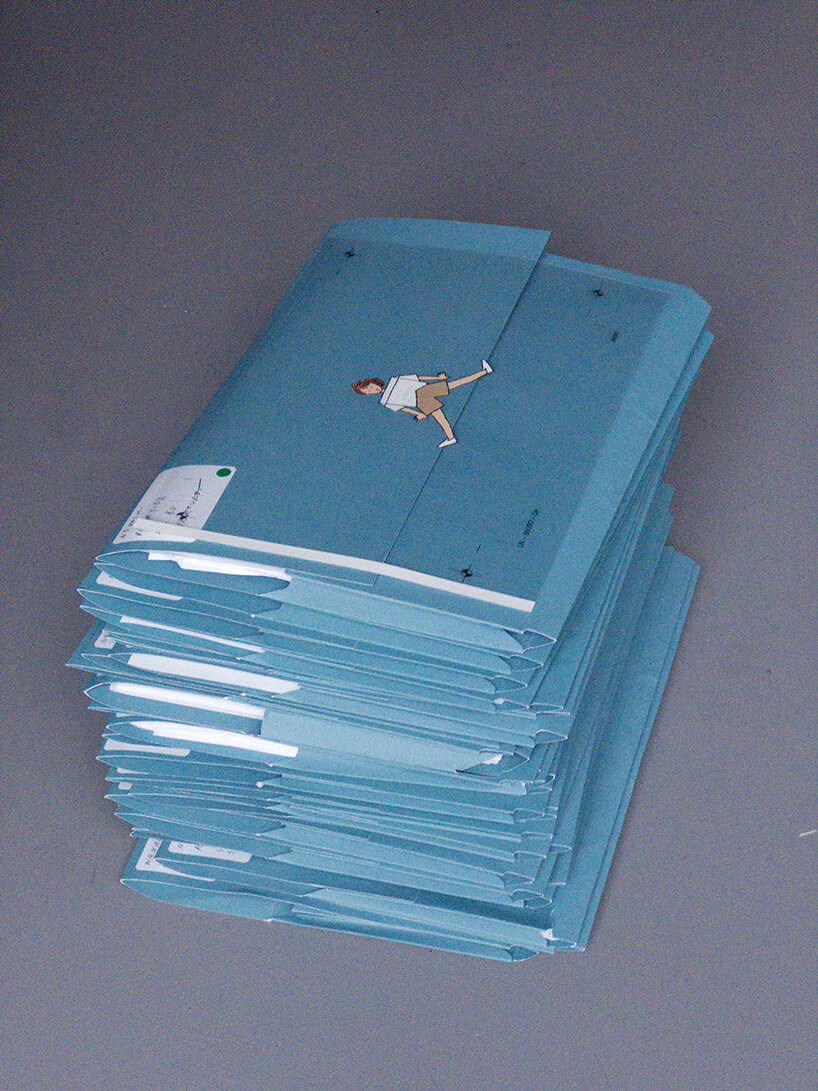
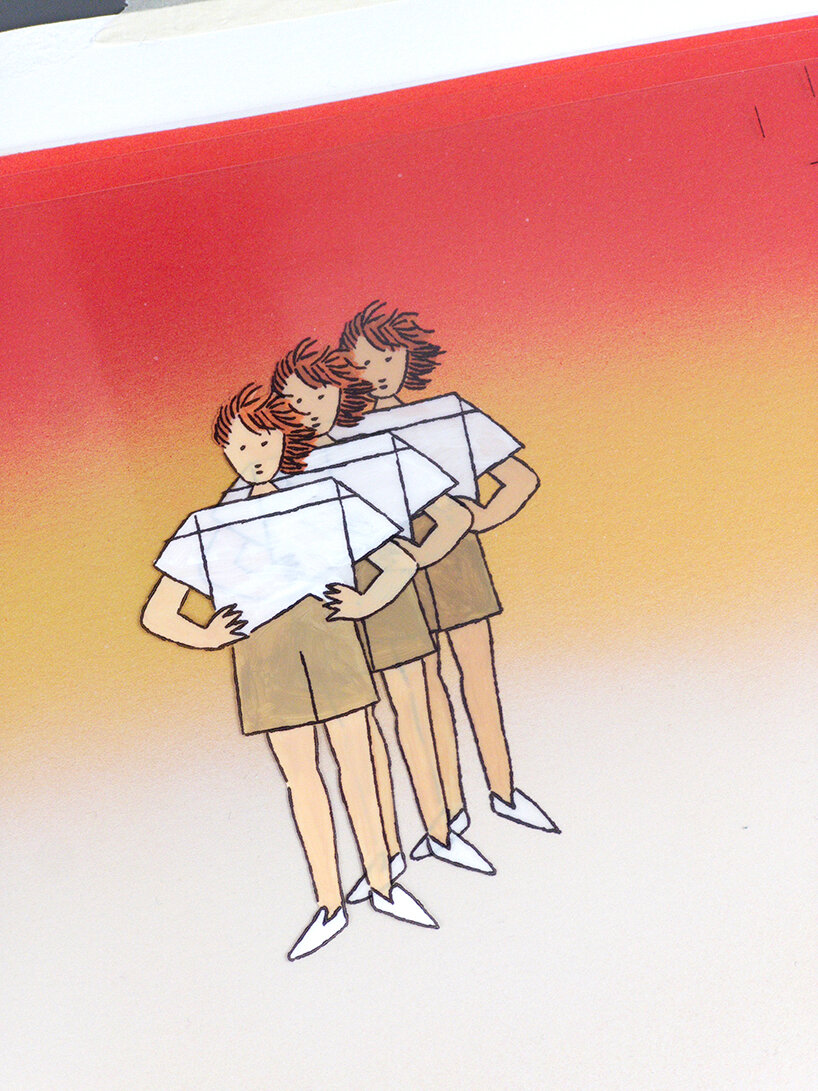
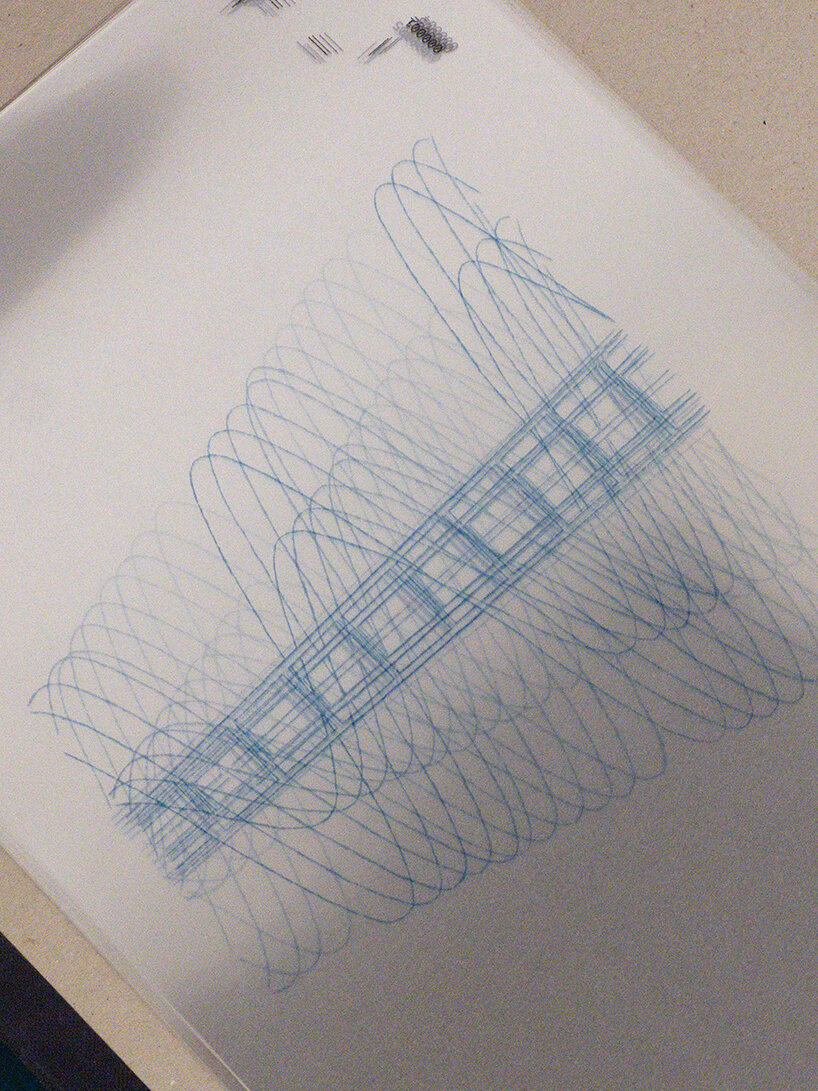
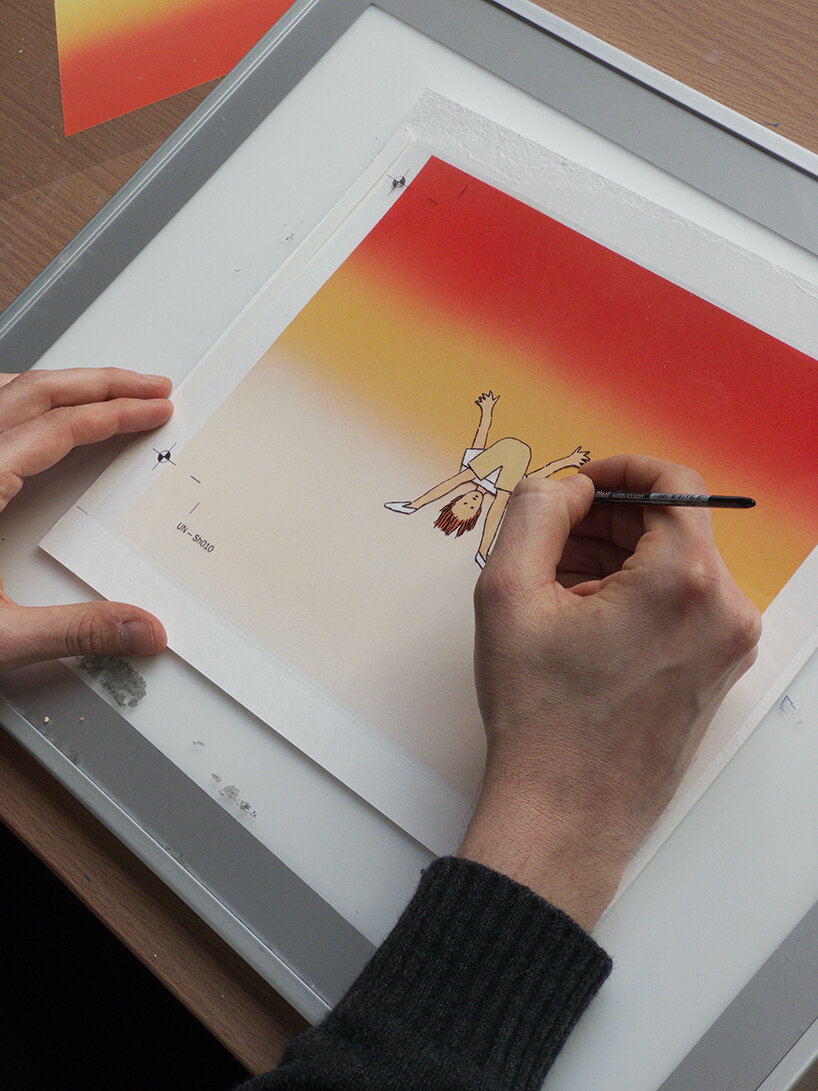
As they immersed themselves in Noguchi’s archive, they realized that the films would need to do something architectural drawings and models rarely can: communicate all the unpredictable ways children invent their own games. ‘Kate was equipped with Noguchi’s drawings and casts of the playgrounds, but felt like a general audience might need a little bit of help to interpret their abstractions,’ they explain. ‘Animation was the ideal medium to provide some extra context on how kids might have enjoyed these constructions.’ Cunningham and Ménard turned to one of animation’s oldest techniques. Every frame was painted by hand onto transparent celluloid sheets using vinyl acrylic paint. Character movement was first planned digitally frame by frame before outlines were transferred onto cels, painted by hand, layered over softly airbrushed backgrounds, and photographed beneath a rostrum camera. More than 1,800 individual cels were produced for the five films.
The directors deliberately left every brushstroke visible. The paint catches the light differently from frame to frame, giving even the quietest scenes a gentle vibration. The animations feel like moving paintings, echoing the tactile quality of Noguchi’s own models. ‘It might seem a little mad in this day and age of automation,’ Cunningham and Ménard tell designboom, ‘but Noguchi was a craftsman whose every mark was apparent on his sculptures.’
‘We felt strongly that if we made them with a technique that would have been contemporary to his productions, we would have a better chance at creating a complementary visual world,’ they add.
imagining how children might have played
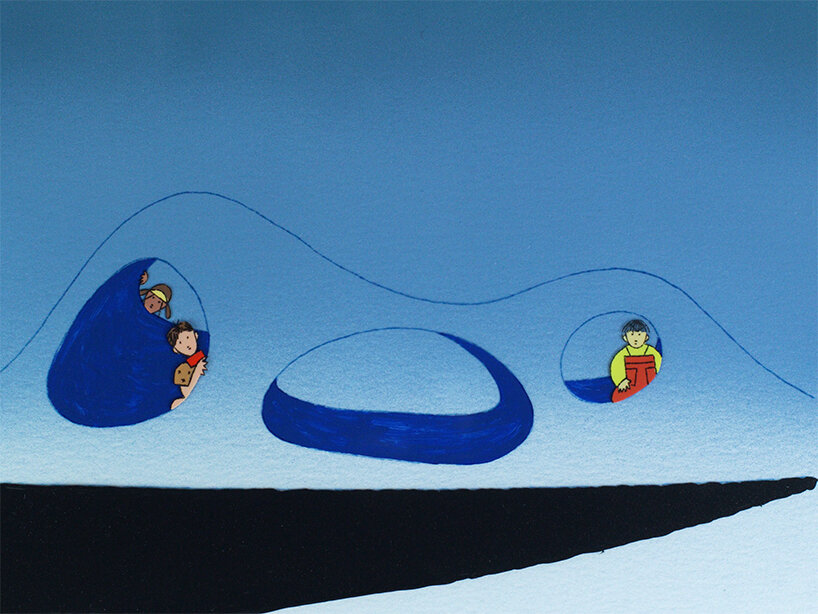
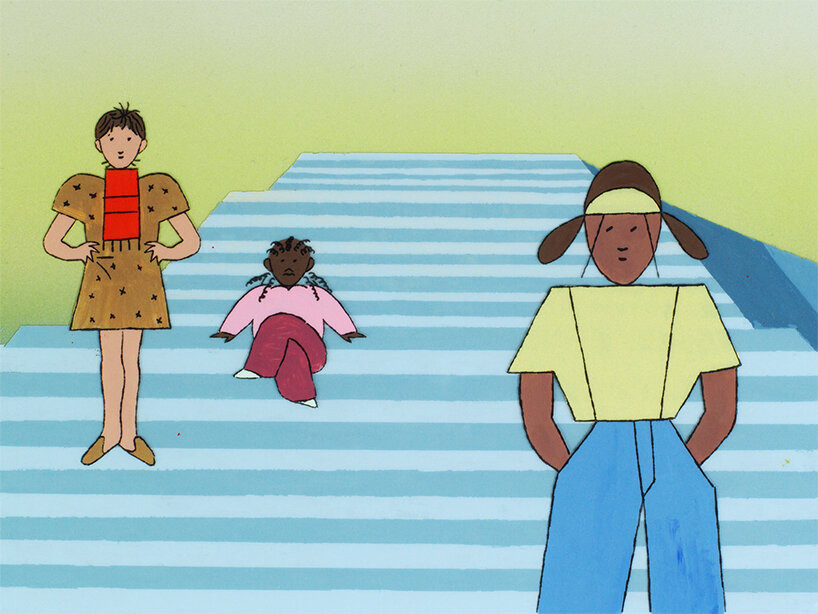
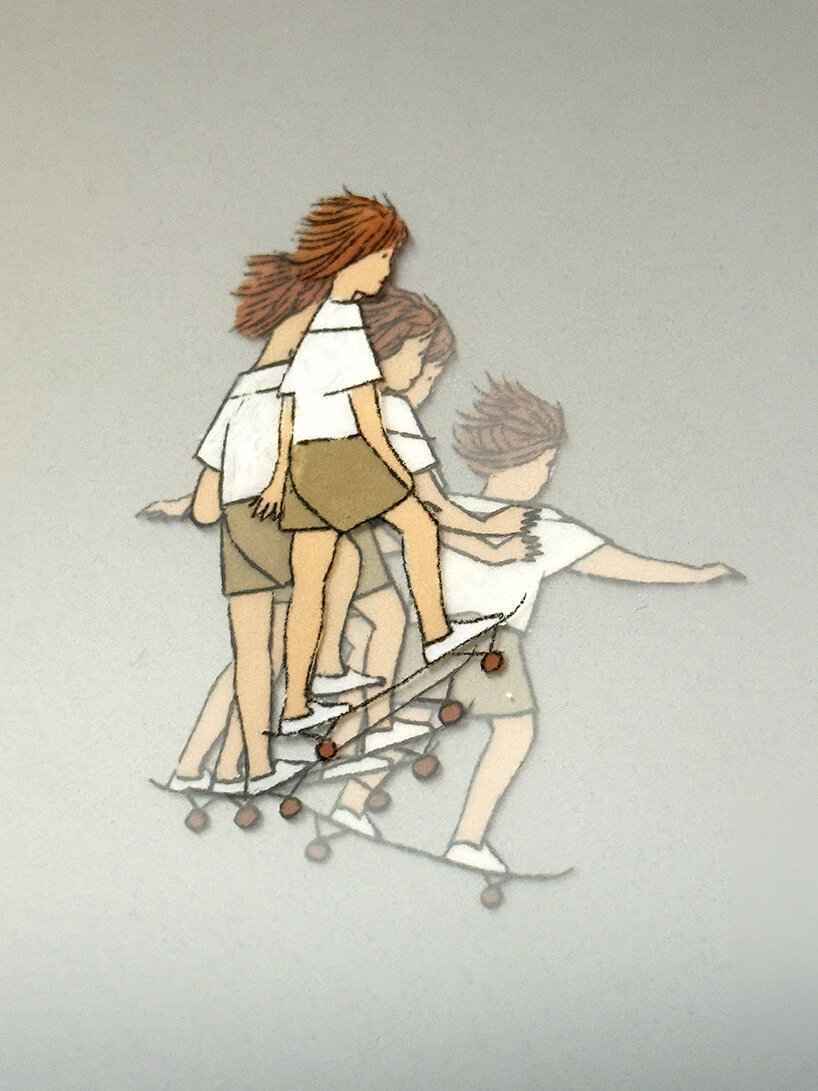
Although united by the same visual language, each film develops its own atmosphere. Play Mountain imagines a magical winter day as children race down snow-covered slopes. Riverside Playground leans into environmental ambience, while Contoured Playground slows into a dreamlike meditation on curved earthworks. The United Nations Playground animation is almost architectural in its gaze, circling Noguchi’s sculptural forms. The children playing collapse time. Some appear dressed in mid-century clothing, others skateboard or wear contemporary silhouettes, suggesting these playgrounds might have remained relevant across generations had they ever been built. ‘Although the main character is the playgrounds and their equipment,’ they explain, ‘we came up with a diverse cast of seven kids, all with their subtly distinct personalities, so viewers could identify with a favourite.’
That relationship between child and landscape sits at the heart of Noguchi’s philosophy. He never imagined playgrounds as collections of prescribed equipment but as sculpted terrains that encouraged discovery without instruction. ‘Noguchi said he wanted kids in his playgrounds to feel as if they were the first people on earth — to experience a profound sense of discovery and wonder,’ Wiener says. The films expand that philosophy rather than simply illustrating it. ‘You can see kids finding new ways to use Noguchi’s spaces, beyond what he might even have thought of, like sailing paper boats through streams of rainwater and skateboarding on the sculpted earth. I think the films really celebrate Noguchi’s capacity to inspire playfulness and creativity,’ the curator adds.
animation as a tool for interpreting unbuilt architecture
Even while making the films, the directors found themselves uncovering new layers within Noguchi’s proposals.
‘When studying the images of Contoured Playground, we weren’t quite sure of the best approach to interpret its subtle moon-like shapes,’ they recall. ‘But when Kate explained how the space could be transformed by rain and water, its purpose became very clear. Noguchi did everything with clarity and intention, even if it might not be evident at first.’
The soundtrack continues that same balance between history and invention. Composer James Hatley developed the score alongside the animation, allowing the music to evolve with the images. Environmental ambience gives way to flute-and-drum marches, delicate harp passages, and subtle electronic textures created using both vintage instruments and contemporary digital tools. Like the animation, the music gently bridges Noguchi’s era with the present day.

bringing noguchi’s idealism to a new generation
For Cunningham and Ménard, the project also points toward a broader role animation can play within architecture.
‘With enough care, animation can add a great deal of charm, humanity and emotion to architectural concepts,’ Cunningham and Ménard share with us. ‘Models and drawings focusing on pure form don’t always address that humans are at the core of their purpose. Adding that context through animation can provide a near instant understanding of a designer’s intentions. And perhaps it might inspire young aspiring architects!’
That idea feels especially relevant today, when architecture is mainly communicated through immaculate renderings that leave little room for imagination. Eastend Western’s films suggest another possibility, allowing viewers to complete the world themselves.
Perhaps that is why one of Wiener’s favorite responses came from a child. ‘A colleague told me her young son was jealous that the animated children got to play in these incredible playgrounds and kept asking when it would be his turn,’ she says. ‘To me, that’s a wonderful testament to how vividly the films bring Noguchi’s vision to life.’
Nearly a century after Noguchi first imagined these playgrounds, they remain unbuilt. Yet for a few minutes, through painted brushstrokes and moving figures, they finally become places waiting to be explored.


project info:
name: Noguchi’s New York – animated playground films
animation directors: Jack Cunningham & Nicolas Ménard
studio: Eastend Western | @eastend.western
commissioned by: The Isamu Noguchi Foundation and Garden Museum
composer: James Hatley
animator: Isaac Holland
painting assistants: Laura N-Tamara, Laurence Thérien
commissioner: The Noguchi Museum
curator: Kate Wiener
featured playgrounds: Play Mountain (1933); Playground Equipment (1940); Contoured Playground (1941); United Nations Playground (1952); Riverside Playground (Adele Levy Memorial Playground) (1961–62)
exhibition: Noguchi’s New York
venue: The Noguchi Museum | @noguchimuseum
location: Long Island City, New York
dates: February 4th – September 13rd, 2026
This interview is part of designboom’s PLAY chapter, exploring what would happen if form didn’t follow function, but pleasure. Discover more stories that celebrate joy, imagination and playfulness here.